
Lewisburg, PA Real Estate Market Report | June 2026
Lewisburg, PA Real Estate Market Report | June 2026
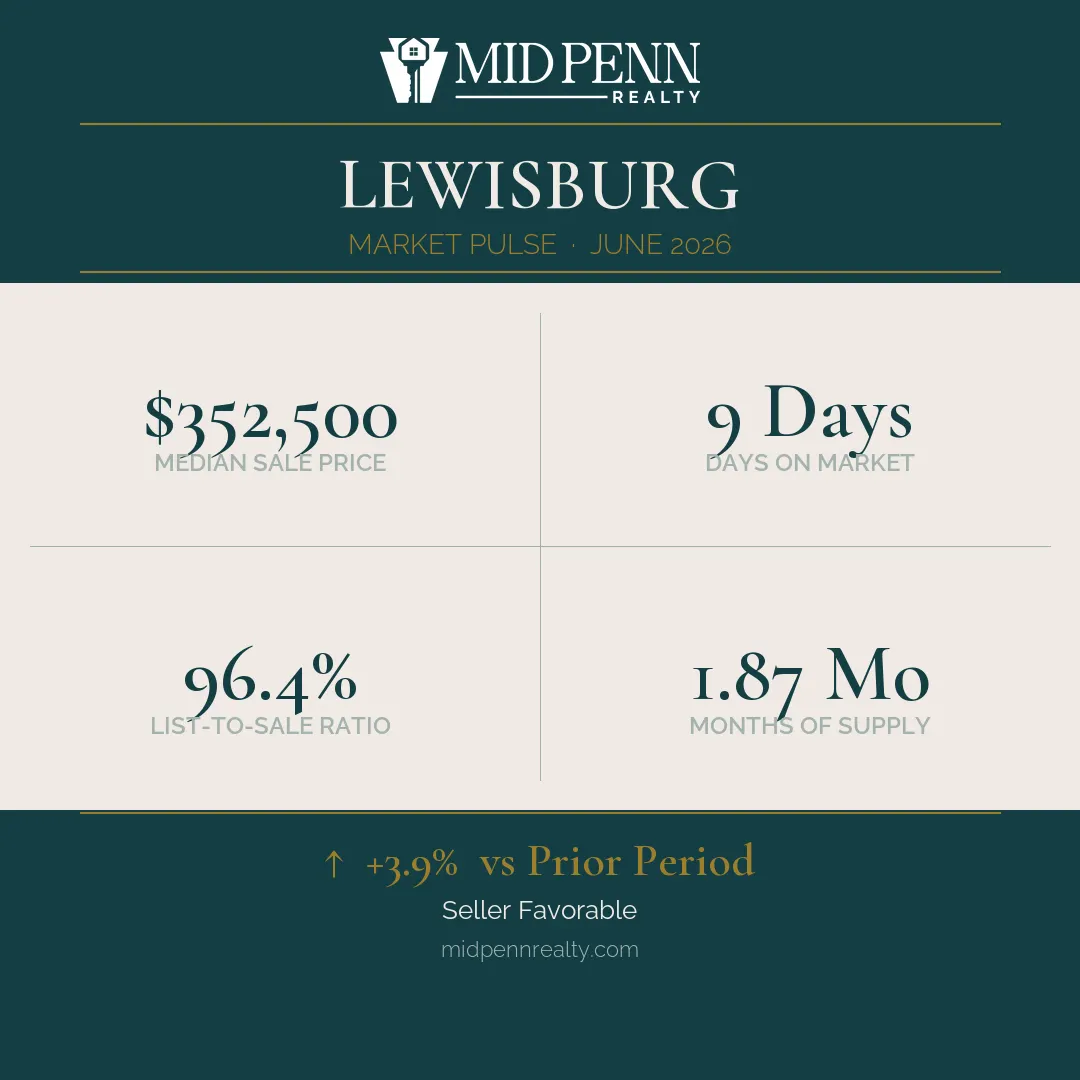
Homes in Lewisburg are selling in nine days, and buyers are paying within a fraction of asking price. That combination tells a clear story about where this market stands heading into spring.
The 17837 ZIP code, which covers Lewisburg Borough and portions of Buffalo Township in Union County, has been a consistently competitive market. The June 2026 data reinforces that trend. With only 28 active listings, a median sale price of $352,500, and a list-to-sale ratio sitting at 96.4 percent, the market is leaning decidedly in favor of sellers. The question worth asking is not just what the numbers say, but what they mean for the people buying and selling homes here right now.
What Is Happening in Lewisburg Right Now
The most meaningful data point in this report is not the price. It is the pace.
Nine days is an exceptionally short time for a home to move from listed to under contract. In a market like Lewisburg, where inventory is already limited, that kind of speed suggests buyers are actively watching the market and moving quickly when something they want becomes available. Homes here are not sitting. They are being evaluated, offered on, and contracted within the first week or two of hitting the market.
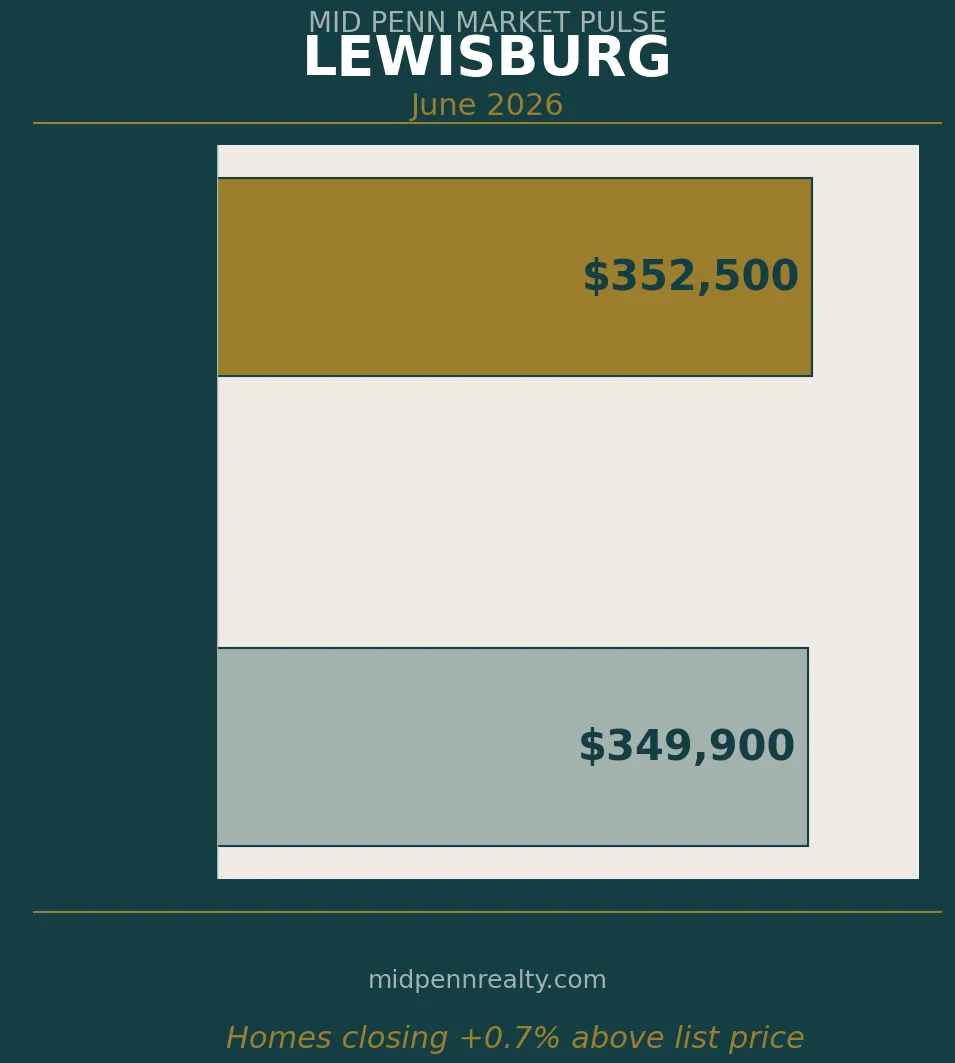
Median sale price came in at $352,500 for the period, slightly above the median list price of $349,900. That relationship is worth noting. When homes routinely sell above their asking price, it typically means multiple buyers are competing for the same property. A 96.4 percent list-to-sale ratio is strong, and the fact that the median sale price slightly exceeded the median list price suggests at least some transactions are closing over asking. That is a meaningful signal, not a minor statistical footnote.
The 3.9 percent increase in pricing compared to the prior period adds context. Prices are not flat here. They are moving. That kind of growth in a market with fewer than 30 active listings at any given time points toward constrained supply as the primary driver, not a sudden surge in demand.
Inventory and What It Reveals
Twenty-eight active listings sounds like a reasonable number until you consider the physical geography and population base of Lewisburg and the surrounding area. Lewisburg Borough itself is relatively compact, home to Bucknell University, a walkable downtown along Market Street, and well-established neighborhoods that rarely see significant turnover. Buffalo Township adds suburban and rural inventory to the mix, but listings there move with their own rhythms.
At 1.87 months of supply, the market is well below the threshold of five to six months that real estate professionals traditionally associate with a balanced market. A balanced market gives buyers reasonable time to evaluate options, negotiate terms, and make considered decisions. At under two months of supply, none of that cushion exists.
Without three years of historical data specific to this ZIP code and reporting period, it is difficult to say precisely how far below normal current inventory sits. What the current data suggests is that supply has not kept pace with demand, and that pattern appears to be influencing both pricing and pace in measurable ways. Historical context on supply levels for Lewisburg would be particularly useful here, and it is something worth tracking over successive reporting periods to understand whether inventory has been declining gradually or has remained consistently tight.
What we can say with confidence is that 1.87 months of supply is a sellers’ market by any recognized standard. Buyers are not navigating a situation with many choices and significant time to decide. They are working with limited options and a tight window.
The Story the Numbers Are Telling Together
Individually, each of these metrics describes one piece of the market. Together, they describe a market under sustained demand pressure with very little relief coming from new inventory.
Rising prices, fast days on market, a strong list-to-sale ratio, and sub-two months of supply are not four separate observations. They are four symptoms of the same condition: more buyers than available homes. That is the defining characteristic of this market right now.
The 3.9 percent price increase is consistent with what happens when supply stays tight and buyer interest remains active entering the spring season. Lewisburg has characteristics that sustain demand independent of broader economic trends. Bucknell University brings a steady rotation of faculty, staff, and administrators to the area. Evangelical Community Hospital, located in nearby Lewisburg, is one of the region’s significant healthcare employers. The proximity to Interstate 80 and the Route 15 corridor connects residents to both the Susquehanna Valley and larger regional employment markets. These are not temporary demand drivers. They are structural.
That structural demand, combined with limited inventory, is what gives this market its resilience. Even when mortgage rates create affordability pressure elsewhere, markets like Lewisburg with durable employment anchors and limited housing stock tend to hold value and maintain velocity.
How This Market Has Been Changing
Without three full years of comparative data for this specific area and period, it is not possible to calculate precise year-over-year changes in price, inventory, or pace with the confidence this analysis normally requires. That transparency matters. Market interpretation should be grounded in actual data, not assumptions.
What the current snapshot does suggest is a market that has shown seller-favorable conditions for an extended period. The combination of metrics present in June 2026 does not look like a market in transition. It looks like a market that has been operating under tight inventory for some time, with pricing that has gradually adjusted upward in response.
If you have been watching Lewisburg for the past several years, this will not feel surprising. What has changed more broadly across Central Pennsylvania is that buyers have largely adjusted their expectations to faster-moving markets. The days of writing an offer with multiple contingencies and extended inspection timelines are largely behind us in markets with this kind of supply profile. Buyers have adapted, and that adaptation has become the new standard for how transactions work here.
What This Means for Buyers
Buying in Lewisburg right now requires preparation that goes beyond pre-approval. Nine days on market means that by the time a buyer schedules a showing, reaches out to an agent, and begins drafting an offer, a property can already be under contract.
Buyers who are serious about this market need to have their financing fully in order before they start touring homes. They should understand their target price range clearly, have a working relationship with an agent who is monitoring new listings actively, and be willing to make decisions without extended deliberation. That is not pressure for the sake of urgency. It is simply a practical description of how this market operates.
The 96.4 percent list-to-sale ratio also means buyers should set realistic expectations about negotiating significant price reductions. In markets where homes sell close to or above asking price, requests for substantial concessions are less likely to succeed. That does not mean buyers have no leverage at all. Inspection results, closing timelines, and other terms still offer room for conversation. But pricing is not a significant area of negotiating power for buyers in this environment.
Buyers should also think carefully about what they can compromise on versus what they cannot. Lewisburg Borough and the surrounding township offer meaningfully different living experiences in terms of walkability, lot size, school access, and proximity to Bucknell’s campus and downtown amenities. Knowing those priorities clearly before beginning the search saves time in a market where time is a limited resource.
What This Means for Sellers
The data here reflects well on sellers’ positioning, but good conditions still require good preparation.
A median sale price of $352,500 with homes selling in nine days tells a seller that the market is receptive. But receptive does not mean careless. Buyers in this market are moving quickly because they have already done their research. They know what comparable properties have sold for, and they are making informed offers. A home that is priced thoughtfully and presented well will perform. One that is priced aspirationally without market support will sit longer than the median and eventually require a correction.
Sellers with properties in Lewisburg Borough, particularly those near Bucknell’s campus, the Market Street corridor, or established neighborhoods with strong walkability, are in a favorable position. There is consistent institutional and professional demand for those locations. Sellers in Buffalo Township and outlying areas may see slightly different dynamics depending on price point and property type, but the overall supply constraint benefits sellers throughout the 17837 market area.
The 3.9 percent price growth also suggests that sellers who have been on the sidelines waiting to see whether values would hold have reasonable cause to feel confident. The market is not showing signs of retreat in the current data.
The Broader Perspective
The Lewisburg market in June 2026 reflects a consistent pattern that has characterized many smaller Central Pennsylvania markets with strong employment anchors and limited housing stock. Demand is real, supply is constrained, and prices are responding accordingly.
The most important thing to understand about this market is not any single metric. It is the relationship between all of them. Fast sales, tight inventory, pricing above asking, and upward price movement are