
Snyder County Real Estate Market Pulse: June 2026
Snyder County Real Estate Market Pulse: June 2026
The most important thing to understand about Snyder County’s real estate market right now is not the price decline. It is that even with prices down, conditions still favor sellers. That combination deserves some careful attention.
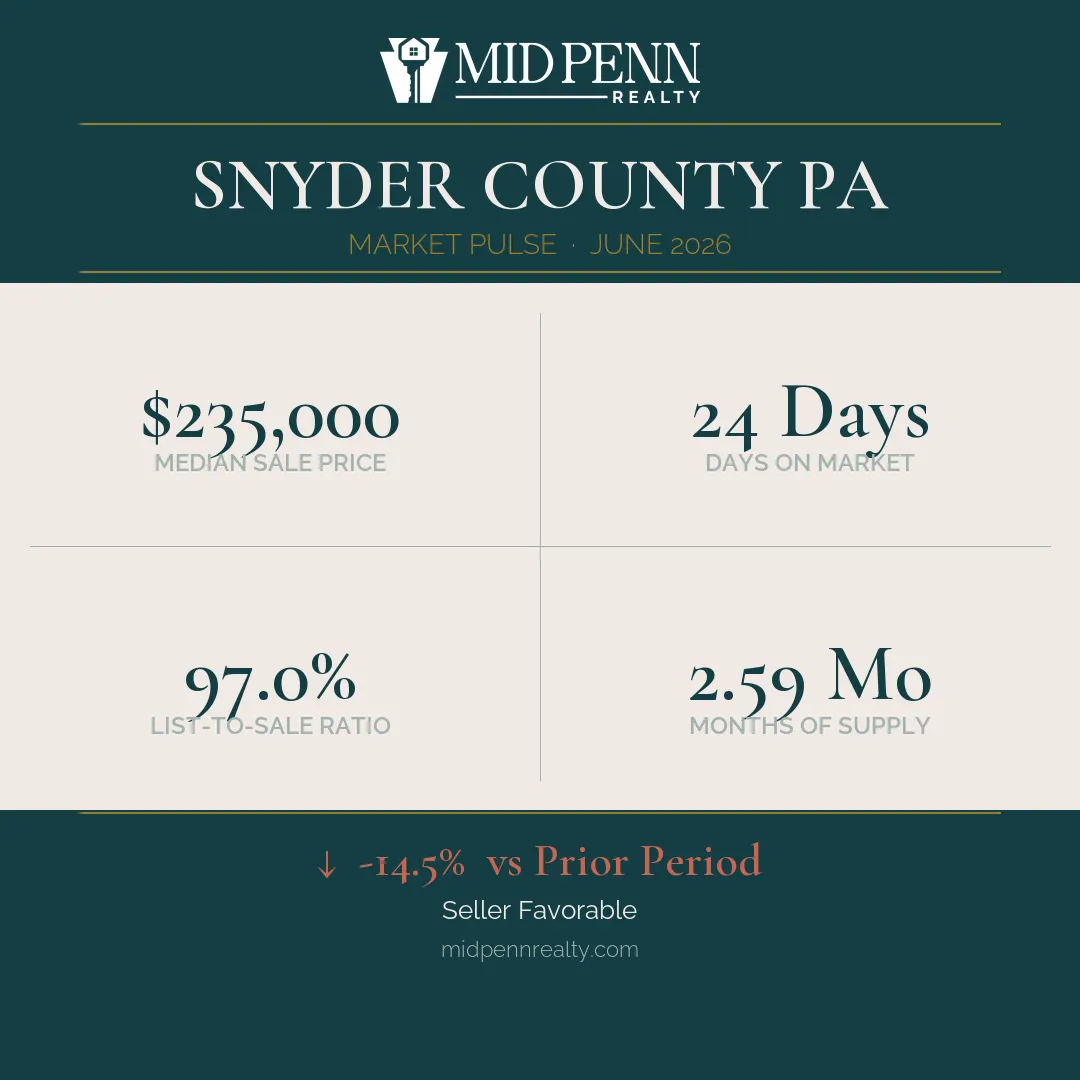
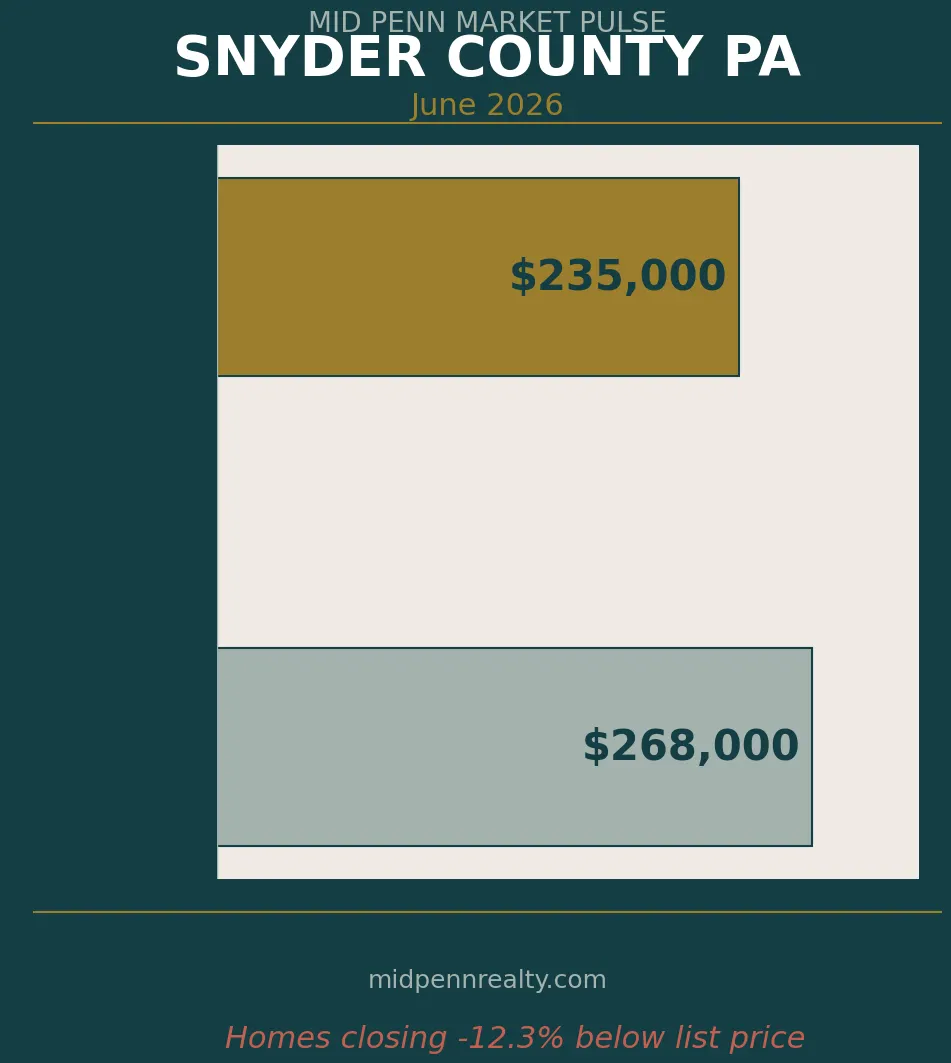
For the period ending June 2026, the median sale price in Snyder County came in at $235,000, against a median list price of $268,000. That gap between what sellers are asking and what buyers are paying is worth noting, and we will come back to it. But the broader picture is one of a market that remains structurally tight. With only 44 active listings countywide and 2.59 months of supply on hand, buyers are still navigating limited choices. Homes are moving to contract in a median of 24 days, and when sales close, they are closing at 97 cents on every listed dollar. That is a competitive market by most standards, regardless of what the price trend line is doing.
So how do we reconcile a 14.5 percent price decline with a seller-favorable designation? That question is worth sitting with for a moment, because the answer reveals something meaningful about where Snyder County stands right now.
The price decline noted in this reporting period reflects movement against a prior period, not necessarily a collapse in underlying value. Markets move in cycles, and pricing in rural Central Pennsylvania has seen periods of compressed appreciation followed by modest correction. What the data suggests here is a recalibration rather than a retreat. Sellers who pushed list prices to the upper range of what the market could support are now meeting buyers who are less willing to stretch. The result is a sale price that lands noticeably below list, yet still within a range that indicates healthy buyer engagement. A 97 percent list-to-sale ratio is not a distressed market. It is a market finding its footing.
Because direct historical comparison data is not available for this specific reporting window, some caution is appropriate when drawing conclusions about how today’s conditions stack up against prior April periods in Snyder County. That said, what the current metrics do allow is a reasonable market-level interpretation based on what the numbers are telling us relative to each other.
A supply figure of 2.59 months sits well below the six-month threshold that real estate economists traditionally associate with a balanced market, where neither buyers nor sellers hold a meaningful advantage. By that standard, Snyder County remains undersupplied. With historical context, we would want to know whether inventory was this tight last April, the April before, and the April before that. The absence of that data does not change what 44 active listings and 2.59 months of supply tells us in practical terms: buyers are choosing from a limited pool, and that dynamic tends to support pricing stability even during periods of nominal price correction.
Twenty-four days on market is a relatively brisk pace. For context, markets where demand has softened typically see homes sitting for 45 to 60 days or longer before finding a buyer. When a home in Selinsgrove, Middleburg, or Beaver Springs goes under contract within three and a half weeks of hitting the market, that is not the pace of a market in distress. It is the pace of a market where motivated buyers are present and moving. Had we three years of April data to compare against, the question would be whether that pace has slowed from where it was. Without it, we can say that 24 days is a figure consistent with an active, engaged buyer pool.
The relationship between days on market, months of supply, and list-to-sale ratio tells a coherent story when read together. Inventory is limited, homes are moving in under a month, and buyers are paying within three percent of asking. Each of those three data points points in the same direction: demand is real. The price decline is the variable that introduces complexity into that picture.
One interpretation worth considering is that the pricing softness reflects a correction in seller expectations rather than a loss of buyer interest. Snyder County, like many rural Central Pennsylvania markets, saw list prices rise sharply in the post-2020 period as demand from buyers seeking space and affordability pushed values well above historical norms. Some of that appreciation was durable. Some of it was speculative. A 14.5 percent decline from a prior period high is not alarming if the prior period high was itself elevated beyond what the local income base and comparable sales could sustain long term.
For buyers, the current environment offers something that has been rare in Snyder County for several years: a real opportunity to negotiate. A 97 percent list-to-sale ratio still favors sellers, but it does leave room for conversation. Buyers who enter the market with realistic expectations, pre-approval in hand, and a clear sense of what they want stand a reasonable chance of finding a home, making a credible offer, and closing without the bidding wars that defined this market during its peak period. The inventory picture remains tight, so buyer selectivity has limits. With only 44 active listings across the entire county, buyers who are too narrowly focused may find themselves waiting longer than they would prefer. But compared to conditions a year or two ago, the current market gives buyers more room to breathe.
The one caution for buyers is timing. Price softness does not guarantee that it will extend further. If inventory remains constrained and demand holds steady, the current recalibration could stabilize relatively quickly. Buyers waiting for further declines in a supply-limited market may find that the window they are waiting for does not open as widely as expected.
For sellers, the data sends a clear message about pricing discipline. The spread between a $268,000 median list price and a $235,000 median sale price is significant. It suggests that buyers in Snyder County are not simply accepting whatever is placed in front of them. They are pushing back on properties priced above what comparable sales support. Sellers who price carefully and present their homes well are still receiving strong offers and closing quickly. Sellers who price at or above the upper end of what the market will bear are likely experiencing the negotiations and price reductions that produced the gap reflected in this data.
The seller-favorable designation in this reporting period is grounded in supply and demand fundamentals. There are not enough homes to meet buyer demand. That reality does not disappear because prices have softened. But it does mean that sellers need to earn their price with thoughtful positioning rather than simply relying on market conditions to carry them.
The broader trend worth watching in Snyder County is whether inventory begins to build as the spring and summer season progresses. More listings entering the market would give buyers additional choices and could put further pressure on pricing. Alternatively, if inventory stays at or below current levels and buyer activity remains steady, the pricing recalibration may prove shallow and short-lived. The market has not signaled which direction it is leaning with enough clarity to call definitively. What it has signaled is that both buyers and sellers benefit from working with someone who understands the local conditions well enough to act on the right information at the right time.
Snyder County is a market defined by its communities rather than its statistics. The families relocating from larger metro areas in search of a different pace of life, the buyers drawn to the employment corridors along Route 15 and the proximity to Sunbury, Lewisburg, and the Susquehanna Valley, the local residents simply looking to move up or right-size, all of them are navigating the same limited inventory and shifting price expectations. The numbers describe the environment. The local knowledge helps people move through it.
If you want a deeper look at how Snyder County’s market is performing and what the current data means for your specific situation, the full Mid Penn Market Pulse report is available at the link below. It covers the metrics discussed here in greater detail and provides the kind of market context that helps buyers and sellers make decisions grounded in real information rather than assumptions.
Request your copy of the full Mid Penn Market Pulse report for Snyder County at go.midpennrealty.com/market-report.